Our activities
Workshop — Training Priests
A residential apprenticeship where priests learn to conduct poojas by standing at real ones, in the tradition kept here.
What this work involves
Recitation and ritual are two different skills. A student can hold a whole Samhita in memory and still not know how to conduct a pooja — where to sit, what to prepare, in what order, what to do when something goes wrong halfway through. None of that is learned from a book, and it is what the workshop is for.
How it runs
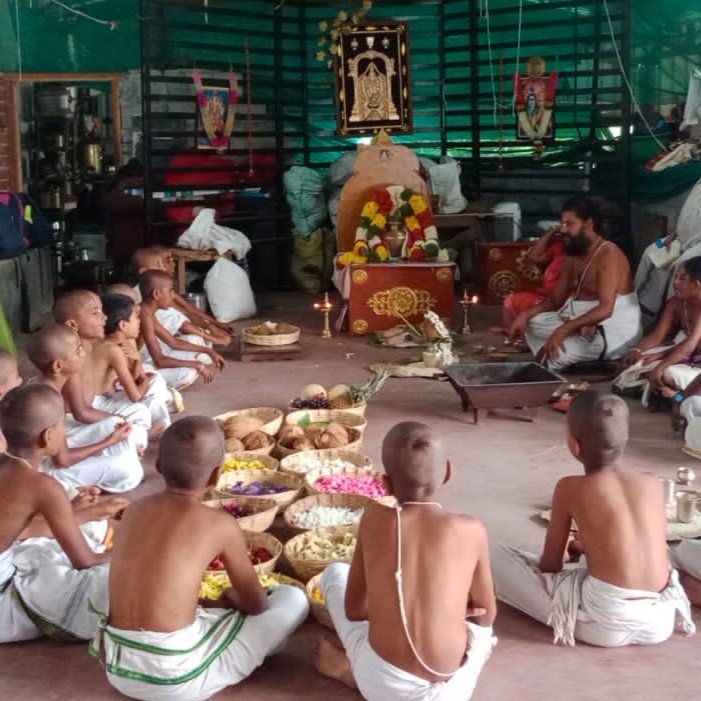
As the old apprenticeship did. A priest comes to the kshetra for a term, is attached to a senior vaidika, and moves through the three stages this training has always had: first watching, then assisting, then conducting with the teacher alongside.
The temple's own daily cycle is the syllabus. There is no practice altar, because the rituals being learned are the ones the sanctum needs performed that morning.
What it covers
The working ground of a temple priest: the daily pooja and abhisheka, the homa, the utsava and festival sequences, and the household samskaras a family will ask for — naming, upanayana, marriage, shraddha.
Alongside them, the things nobody writes down. How the altar is laid. How the offerings are prepared. How mantra is pronounced when it is spoken rather than chanted. How to sit with a family on the worst day of their life.
Priests serving in any temple are welcome to apply, and the trust provides accommodation and meals for the term at no cost — no one should have to choose between learning the work properly and feeding a household.
At a glance
- A residential term, not a weekend course
- Watch, then assist, then conduct — beside a senior vaidika
- Daily pooja, abhisheka, homa and the festival sequences
- The household samskaras a family will ask for
- Accommodation and meals provided for the term
- Open to priests serving in any temple
Applying for a term
Open to priests serving in any temple. Telephone the office to ask when the next term begins.
In pictures
What it looks like
Select any photograph to see it full size.
Keep reading
Our other work
Would you like to help?
The gurukulam teaches free of cost and the kitchen serves whoever arrives — both carried entirely by what devotees give.
Give now by UPI or bank transfer, with an 80G certificate if you need one. Or write to the office to sponsor a particular day of annadana, offer time during a festival, or ask what is needed most — those take a date and a person rather than a payment.