About the foundation
Sri Yatirajadasar — more than ten centuries of unbroken service
The Melukote Guruji Foundation is the charitable work of the Sri Yatirajadasar sthanacharya house of Melukote (Melkote) — entrusted by Acharya Sri Ramanuja as sthanacharya of the Sri Cheluvanarayana Swamy Temple in 1080 C.E., and serving it without a break since.
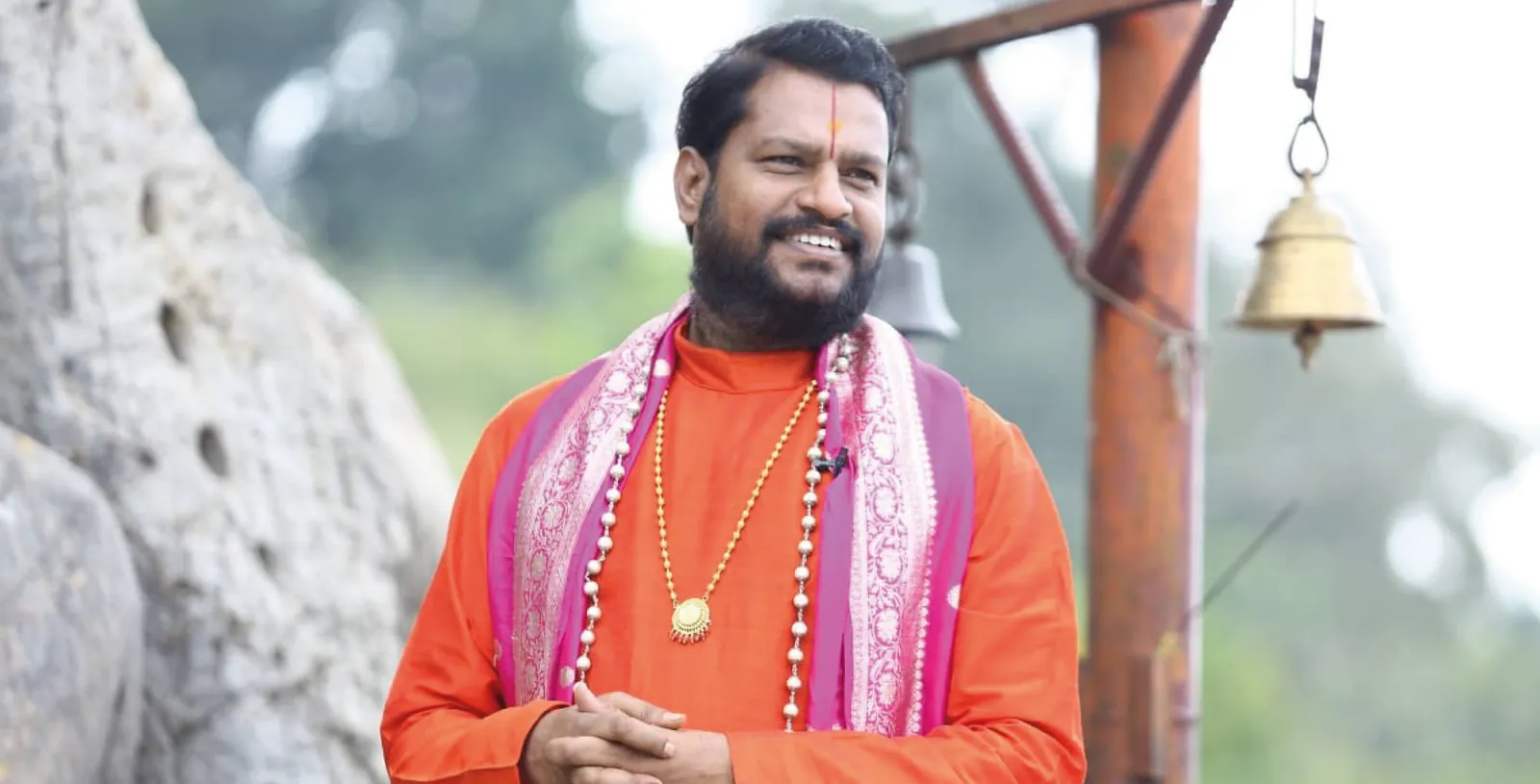
Our Guruji
Sri Srinivasanarasimhan Guruji
Sthanacharya, Sri Cheluvanarayana Swamy Temple
- Addressed in the temple as
- Sri Yatirajadasar
- Known in the villages as
- Elachi Marada Gurugalu — the gurus of the elachi tree
Guruji carries a responsibility his house has held for nearly a thousand years: the daily service of the Melukote temple and the teaching of the tradition that surrounds it. Since 2016 he has held it with his brothers, as the house has always held it — together.
Under his guidance the foundation established Sri Vijayalakshmi Vedagama Jyothishya Samskrita Gurukulam, which today houses and teaches students drawn from temples across Karnataka — none of whom pay anything to be there.
Alongside the gurukulam he oversees the temple's festivals and poojas, the daily annadana, the health and welfare camps in surrounding villages, and the care of the kshetra's cattle and groves.
The parampara
Four houses, and one of them ours
When Sri Ramanuja rebuilt the Melukote temple he did not leave its running to chance. He appointed four of his closest disciples as its sthanacharyas — and fifty-two others, the Aimbattiruvar, to fifty-two named offices.
Sri Tiruvanantapura Dasar
Understood to have served the temple at Thiruvananthapuram in Kerala
Sri Tirukkurungudi Dasar
Understood to have served the Tirukkurungudi temple in Tamil Nadu
Sri Malakara Dasar
Came, like the others, from the Chola country
Sri Yatirajadasar
This houseHeld the administration of the Sri Pundarika Perumal temple at Tiruvellarai — but was named not for that place, as the others were, but for Ramanuja himself
Why this house carries his name
Three of the four houses are named for the temples they served before Melukote. The fourth is named for Ramanuja himself — Yatiraja, king of ascetics — because this was the house of the disciples dearest to him. To this day every member of the house is addressed in the temple as Sri Yatirajadasar rather than by his own name.
The villages know them by something plainer. The house worships Badari Narayana Swamy, the presiding deity of the kshetra, and above that shrine stands an ancient badari — elachi — tree. Disciples looking for their guru found the tree first, and the name stuck: the gurus of the elachi tree. The tree is still there.
A household, not a monastery
This is a grihastha gurupeetha — a guru lineage inside householder life, observing the six duties of study and teaching, sacrifice and officiating, giving and receiving. It is not a sannyasi matha, and the family's own history is emphatic on the point.
It changes what a visitor should expect. There is no audience to be granted here. The lessons, the discourses, the homas and the samskaras happen in a house that people walk into, and have for nine hundred years.
One hill, five names
- Vedadri
- In the Kritayuga
- Yadavadri / Yadavagiri
- In the Dvaparayuga
- Yatishaila
- In the Kaliyuga
- Tirunarayanapuram
- In historical record
- Dakshina Badarikashrama
- In every age
Our history
How the trust came to be
A short account of the lineage, and of what it looks like in practice today.
c. 1080 C.E.
A trust is given
Having rebuilt the Melukote temple, Acharya Sri Ramanuja appoints four of his closest disciples as its sthanacharyas — responsible for its rites, its traditions and its administration alike. One of the four houses is Sri Yatirajadasar, named for Ramanuja himself rather than for the place it came from. This foundation is that house.
12 years
Ramanuja at Melukote
Sri Ramanuja spends about twelve years here, recovering the murti of Tirunarayana, setting the temple's daily worship on the Pancharatra Agama, and turning forest into a town. The four houses feed him by turns for the whole of it — and go on feeding the image he leaves behind.
1976 – 2016
Held through the lean years
With the family's lands gone and the temple offices carrying no income, the household spent some twenty years in real poverty. Sthanikam Nagaraja Ayyangar kept every observance rather than take paid work elsewhere, and taught his children the tradition and a modern education both.
Today
The same duties, in present form
Sri Vijayalakshmi Vedagama Jyothishya Samskrita Gurukulam teaches and houses students from temples across Karnataka at no cost to their families. The kitchen does not close, the goshala fills, and the villages around the hill are looked after — which is the old list of duties, written out again.
Unbroken
The Bhiksha Kainkarya
For the twelve years Ramanuja lived here, the four houses fed him — each taking its turn, day by day, so that the Acharya should lack nothing. Before he left for Srirangam he told them to go on offering that same meal to the image he left behind. They have not stopped.
On the ninth day of Ramanuja's Tirunakshatra the rathotsava is drawn, and afterwards he is taken to the Yatirajamatha where he lived, for an ekanta abhisheka. When the Bhashyakara returns to the temple, it is this house that offers him bhiksha.
The men of the house fast from the morning of that day until the offering is made at night. Fruit, flowers, betel leaf and areca, coconut, camphor, oil, ghee, wicks and milk are carried from the house and set in order before him, and the night's pooja begins.
A thousand years on, the offering is made as though to a living guest — which is precisely how the family describes it, and the reason none of them treats the fast as symbolic.
Nemi seve
Observances that belong to this house
Conducted every year without fail since about 1080, at the house's own expense — which is what nemi seve means. The temple has treated them as the house's right from that day to this.
Makara Sankranti pushpa kainkarya
January (Makara Sankranti)
From midday, flowers, fruit and dried fruit with betel leaf, areca and coconut are arranged on hundreds of plates before Badari Narayana Swamy. As the utsava leaves the temple, flowers are carried out from the house on the head and offered, and turmeric is given to Sridevi and Bhudevi the way it is given to a married woman who comes to the door.
Vasantaraga seve
Sankranti night
The Vasantaraga is sung before the mula murti of Sri Cheluvanarayana Swamy, and the Areyar announce before the Lord whose kainkarya it is.
Naivedya within the sanctum
At the close of the sahasranama archana
Members of this house carry the naivedya into the garbhagriha and offer it to the Lord there. Every other offering at Melukote is made from the shukanasa, outside it.
What the house is for
The duties, as its own records list them
Ramanuja set these down himself, in the Udaiyavar Niyamanapadi. Nearly every part of this foundation's work turns out to be one of them, written out again.
The Veda, studied and taught
Adhyayana and adhyapana — learning the Veda and teaching it on — together with the Agama shastras, Jyothishya and Ayurveda. The gurukulam is this duty, in its present form.
The fire, kept
Vedadhyayana homa and the havanas, conducted in the order the shastra sets down. Shanti homas for those in distress, and the Kushmanda homa with the Brahmakurcha rite for the gravely ill.
The temple's offices
Reciting the namavalis; the vyajana and chamara seve for Sri Cheluvanarayana, Sri Yadugiri Nayaki and Sri Ramanuja; the care of the ornaments; and the administration of the peetha.
The samskaras of a household
Namakarana, chaula, upanayana and marriage, performed to shastra and without ceremony about it. Samashrayana and mantra-diksha for those who ask.
The kshetra's own deities
The daily aradhana of Badari Narayana Swamy, the presiding deity of the kshetra, and the special aradhana of Kavigallu Anjaneya Swamy.
Teaching, and consolation
Pravachana and discourse so that Sanatana Dharma is understood rather than merely inherited — and, the documents put it plainly, the consoling of grieving minds.
Mission and values
What we hold ourselves to
Our purpose is to keep the Vedic tradition of Melukote in living practice, and to make sure that everyone who comes to the kshetra — student, pilgrim or villager — leaves better cared for than they arrived.
Given freely
No student of the gurukulam pays a rupee for teaching, food or lodging, and no one is turned away from the annadana hall.
Without distinction
Caste, faith, means and origin have no bearing on who we serve. Need is the only criterion we apply — and this is the oldest thing about us, not the newest: Sri Ramanuja held that the Lord is reached through devotion and surrender without distinction of caste, creed, gender or country, and taught it at a cost to himself.
Tradition, taught well
The Vedas are learned the way they have always been learned — orally, from a teacher — but taught with the care and structure a child deserves.
Accountable to devotees
This work runs on the generosity of others. We treat every contribution as a trust to be accounted for.
Where this history comes from
The account on this page is translated from the lineage's own published records and from the temple's inscriptions. Where a claim rests on the tradition's account of itself rather than on a document, the wording above says so.
Sri Yatirajadasar Vamsha Vaibhava
The lineage's own history, by Sthanikam Dr. Shalvapillai Ayyangar — published in Kannada by Sthanikam Prakashana, Melukote.
Sri Ramanujara Tirumanjana Kattiyam
Sthanikam Prakashana, Melukote, 2023. Its editors' foreword sets out the four houses and the Bhiksha Kainkarya.
Epigraphia Carnatica, vol. 6 (Pandavapura)
The Melukote stone inscriptions — nos. 125, 130, 132, 135, 138, 140, 152, 163 and 179 among them — which name the sthanacharyas and record that nothing proceeded without their consent.
Udaiyavar Niyamanapadi
Ramanuja's own record of the rules he set for the temple. It names Sri Vishvaksena Bhattar, and the sites granted to his household.